
The Indian financial services market has seen a sharp rise in interest around nbfc for sale opportunities. Entrepreneurs, private investors, fintech founders, and corporate groups are actively exploring nbfc for sale in India instead of applying for a fresh NBFC registration.
The reason is practical. A fresh NBFC license requires high capital commitment, strict scrutiny by the Reserve Bank of India (RBI), and long waiting periods. Even after meeting all conditions, approval is not guaranteed.
Buying an existing NBFC allows faster entry into the lending and financial services space. However, this route is fully regulated and must comply with RBI rules. This blog explains everything you need to know about nbfc for sale, nbfc license for sale, nbfc company for sale, how to buy nbfc, and how BSE listed NBFC for Sale transactions work.
What Does NBFC for Sale Mean?
An nbfc for sale means an existing company that already holds a valid Certificate of Registration (CoR) from RBI is being transferred to a new owner through shareholding or control change.
Key legal clarity:
- RBI licenses cannot be sold separately
- There is no such thing as a standalone nbfc license for sale
- What is sold is the company that owns the license
This makes every nbfc company for sale a regulated transaction.
Official RBI FAQ: https://www.rbi.org.in/commonman/english/scripts/FAQs.aspx?Id=1167
New NBFC Registration vs NBFC for Sale in India
Applying for a new NBFC registration in India is a structured and closely regulated process. It typically involves:
- Minimum Net Owned Fund (NOF) of ₹10 crore, kept as blocked capital
- Detailed background checks of promoters and directors
- Review of business plan and financial projections
- Regulatory inspection and internal review
- Approval timelines ranging from 9 to 18 months
In recent years, the Reserve Bank of India has tightened approvals under its scale-based regulatory framework, making new registrations more selective.
Regulatory reference:
https://www.rbi.org.in/Scripts/BS_PressReleaseDisplay.aspx?prid=53066
Why Investors Prefer NBFCs for Sale in India
Because of long timelines and approval uncertainty, many investors prefer buying an existing NBFC.
Common reasons include:
- Faster operational launch
- Existing RBI registration
- Lower regulatory uncertainty
- Immediate banking and statutory relationships
A clean, compliant NBFC for sale allows businesses to move quickly while maintaining regulatory continuity.
When a New NBFC Registration Makes Sense
Applying for a fresh NBFC registration can still be the right option in certain situations:
- Full control over structure and compliance history
- No legacy issues or past operations
- Suitable for long-term, institution-backed plans
- Ideal for promoters comfortable with longer approval timelines
A new NBFC offers a clean slate and full customization, as long as capital lock-in and waiting periods are not a concern.
Choosing the Right Path
Both options have clear advantages.
- A new NBFC registration offers control, transparency, and long-term clarity.
- An NBFC for sale offers speed, certainty, and immediate market entry.
The right choice depends on your timeline, capital strategy, and regulatory comfort. When evaluated carefully, both paths can lead to a strong and compliant NBFC business in India.
Types of NBFCs Available for Sale
Before buying an NBFC in India, it is important to understand NBFC classification. Each type of NBFC has different rules, permitted activities, and compliance requirements set by the regulator.
Most NBFCs available for sale are RBI-registered, non-deposit-taking companies. These are usually clean or dormant entities with no active lending. Buyers use them to start operations faster, especially in areas like MSME loans, vehicle finance, gold loans, or digital lending.
Choosing the right NBFC type at the start can save time, cost, and regulatory risk later.
Common NBFC Types Available for Sale
NBFC – Investment and Credit Company (NBFC-ICC)
This is the most common NBFC available for sale in India. It can provide loans and make investments. NBFC ICCs are widely used for personal loans, MSME lending, and corporate finance. Their flexibility makes them a preferred option for many buyers.
Loan-Based NBFCs
These NBFCs focus mainly on lending. Typical loan products include personal loans, business loans, MSME finance, and vehicle loans. Most loan-based NBFCs operate under the ICC category.
Asset Finance Companies (AFCs)
AFCs finance physical assets such as commercial vehicles, machinery, construction equipment, and agricultural tools. These NBFCs are common in transport and equipment finance businesses.
Microfinance Institutions (NBFC-MFI)
NBFC-MFIs provide small, unsecured loans to low-income and underserved borrowers. They mainly operate in rural and semi-urban areas. These NBFCs follow strict rules on loan size, borrower income, and interest rates.
NBFC – Peer-to-Peer (P2P) Lending Platforms
P2P NBFCs run online platforms that connect lenders and borrowers directly. They must follow strict rules related to escrow accounts, fund flow, and reporting.
Housing Finance Companies (HFCs)
HFCs provide loans for buying, building, or repairing homes. These companies have higher compliance requirements and are usually suitable for experienced or well-funded buyers.
Infrastructure Finance Companies (IFCs)
IFCs finance long-term infrastructure projects such as roads, power plants, and urban infrastructure. These NBFCs require high capital and are generally acquired by large institutions.
Core Investment Companies (CICs)
CICs mainly hold shares in group companies. They do not focus on public lending. These are used for holding structures and group-level investments.
Gold Loan NBFCs
Gold loan NBFCs provide loans against gold as collateral. These companies are closely monitored due to risks related to gold valuation and asset concentration.
Deposit-Taking vs Non-Deposit Taking NBFCs
Most NBFCs available for sale are Non-Deposit Taking NBFCs (NBFC-ND).
Deposit-taking NBFCs are rarely sold because they face stricter supervision and higher compliance requirements from the Reserve Bank of India.
Regulatory Reference
NBFC classification and rules are governed by RBI Master Directions.
Official reference: https://www.rbi.org.in/Scripts/BS_ViewMasDirections.aspx?id=12300
Who Is Eligible to Buy an NBFC?
To buy nbfc, buyers must meet RBI’s “Fit and Proper” criteria.
Applicable to:
- Indian individuals
- Companies and corporate groups
- LLPs and holding entities
- Foreign investors (subject to FEMA)
RBI evaluates:
- Source of funds
- Financial credibility
- Integrity and reputation
- Ability to manage financial business
Failure to meet these standards leads to rejection of nbfc for sale in india applications.
RBI Approval Rules for NBFC Sale and Takeover
RBI approval is mandatory in most NBFC sale cases.
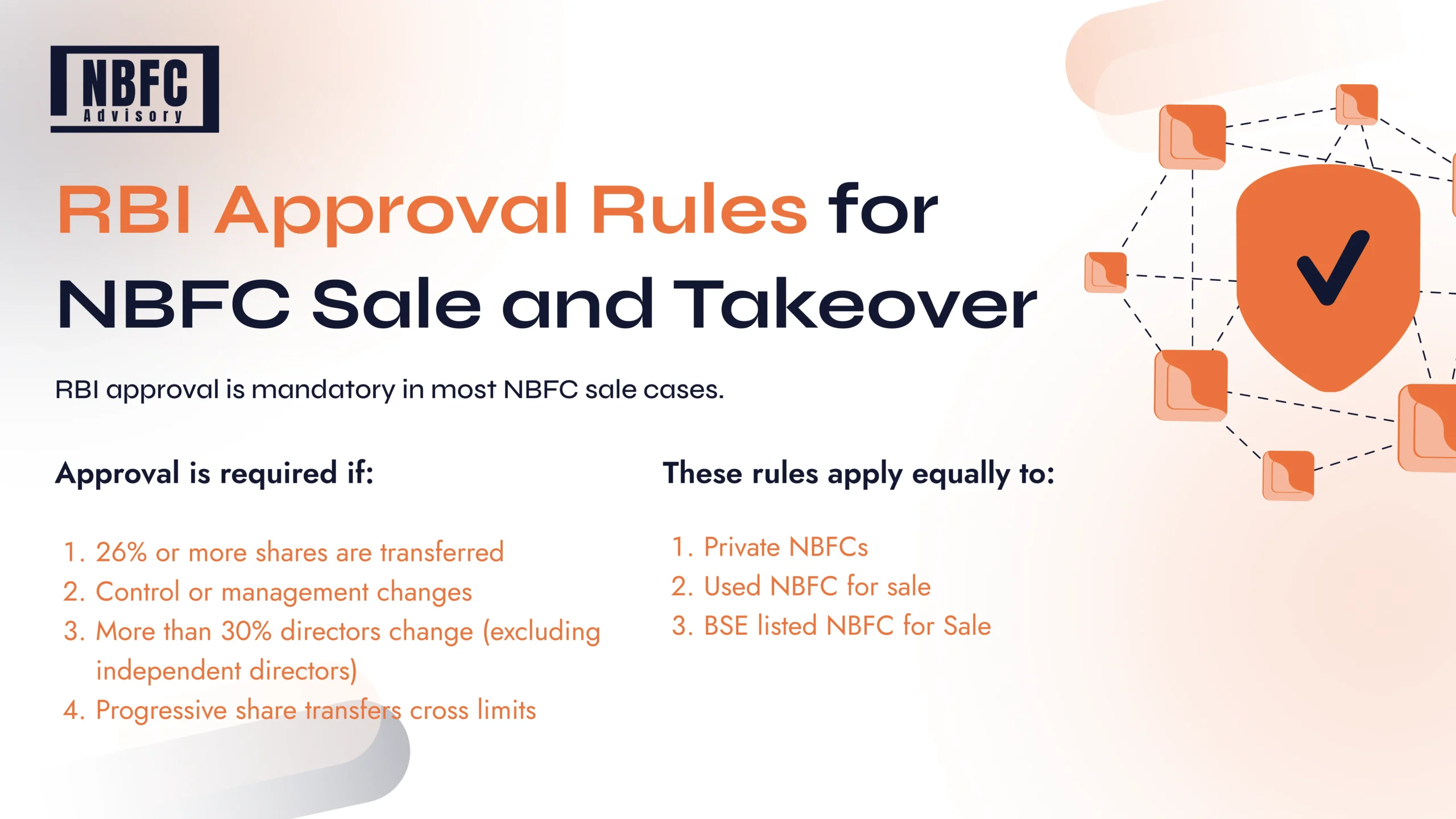
Approval is required if:
- 26% or more shares are transferred
- Control or management changes
- More than 30% directors change (excluding independent directors)
- Progressive share transfers cross limits
These rules apply equally to:
- Private NBFCs
- Used NBFC for sale
- BSE listed NBFC for Sale
RBI NBFC takeover guideline: https://www.rbi.org.in/Scripts/BS_ViewMasDirections.aspx?id=12301
Legal Structure of NBFC Acquisition
A compliant nbfc for sale in india follows one of the below structures:
Share Transfer Model
Buyer acquires shares from existing shareholders after RBI approval.
Control Transfer Model
Management control transferred first, followed by share transfer with RBI consent.
Both models require disclosure and RBI approval.
Due Diligence: The Backbone of NBFC Sale
Before finalizing any nbfc for sale, due diligence is mandatory.
Key checks include:
- RBI Certificate of Registration validity
- Net Owned Fund compliance
- RBI inspection history
- Loan book quality and NPAs
- Statutory and tax filings
- Litigation and penalties
- Related-party transactions
- KYC and AML systems
Due diligence prevents buyers from acquiring risky nbfc company for sale entities.
Detailed checklist reference: https://taxguru.in/rbi/nbfc-takeover-process-rbi-compliance.html
Valuation of NBFC for Sale in India
NBFC valuation depends on multiple factors:
- Clean compliance record
- Dormant vs active operations
- Loan book quality
- Capital adequacy
- RBI regulatory standing
Dormant but compliant nbfc for sale entities often attract premium pricing due to low regulatory risk.
Documents Required for NBFC Sale
A compliant nbfc for sale in india requires:
- Share Purchase Agreement
- RBI approval application
- KYC documents
- Board and shareholder resolutions
- Audited financial statements
- Fit and Proper declarations
- Public notice drafts
Missing documentation delays RBI approval.
Post-Acquisition Compliance Obligations
After acquiring an nbfc for sale, buyers must:
- Inform RBI of ownership change
- Maintain minimum capital
- File periodic RBI returns
- Implement AML and KYC systems
- Appoint compliance officer
Failure can lead to penalties or cancellation of NBFC registration.
Tax and Cost Considerations
Costs beyond purchase price include:
- Stamp duty on share transfer
- Capital gains tax (seller side)
- Legal and advisory fees
- RBI compliance costs
- Operational restructuring expenses
Ignoring these can make a cheap nbfc for sale expensive.
Foreign Investors and NBFC for Sale in India
Foreign investors can buy nbfc, subject to:
- FEMA regulations
- RBI approval
- Beneficial ownership disclosure
- Source-of-funds verification
FEMA reference: https://www.rbi.org.in/Scripts/FAQView.aspx?Id=26
There is no relaxation in RBI scrutiny for foreign buyers.
BSE Listed NBFC for Sale
A BSE listed NBFC for Sale follows additional regulations.
Key points:
- SEBI takeover code applies
- Open offer obligations may trigger
- Continuous public disclosure
- Market-driven pricing
SEBI takeover code: https://www.sebi.gov.in/legal/regulations/aug-2011/sebi-substantial-acquisition-of-shares-and-takeovers-regulations-2011_29356.html
Common Risks in NBFC Sale Deals
Risks in nbfc for sale transactions include:
- Hidden NPAs
- Weak loan documentation
- Regulatory non-compliance
- Shell lending structures
- Unreported RBI notices
Professional advisory support mitigates these risks.
NBFC Registration vs Buying NBFC
Fresh Registration:
- Long approval timeline
- Capital locked
- High uncertainty
Buying NBFC:
- Faster entry
- Existing license
- Higher upfront cost
For speed and certainty, many investors prefer nbfc for sale in india.
Conclusion:
Buying an nbfc for sale is not just a transaction. It is a regulated shift of responsibility under RBI supervision. An nbfc for sale in india can give you speed, an existing license, and a ready structure but only when the NBFC is clean, compliant, and transferred the right way.
Many buyers rush on price or timelines and miss the real risks: weak compliance history, hidden NPAs, incomplete RBI approvals, or post-takeover reporting gaps. The moment you buy nbfc, every past and future obligation becomes yours. This applies whether you are considering a used nbfc for sale, an nbfc license for sale, or a BSE listed NBFC for Sale.
This is where experienced guidance matters. At NBFC Advisory, the focus is on structured, regulator-ready acquisitions, from identifying the right nbfc company for sale, managing RBI approvals, to ensuring long-term compliance after takeover.
In the NBFC space, speed without structure creates risk. The right advisory approach turns an NBFC acquisition into a stable, compliant, and scalable financial platform.