If you are building a lending-focused FinTech in India, there is one decision that shapes everything that follows. Before growth, before marketing, before funding, you must decide how you will lend. Not what product you will build, not who your customer is, but the structure through which money will actually flow.
At the centre of this decision is a choice between nbfc collaboration and building an independent lending model. Most early-stage companies underestimate how deeply this choice affects compliance, scalability, investor confidence, and long-term survival.
This blog explains both models clearly, shows how they work in real life, and helps you choose the best one for your current stage and goals.
Why lending structure matters more than product
In India, lending is not just a business activity. It is a regulated function governed by the Reserve Bank of India. This means you cannot legally lend money simply because you have technology, data, or customer demand.
Every loan must sit on the books of a regulated entity. Every interest rate, fee, recovery process, and customer grievance is subject to regulatory oversight. This is why nbfc collaboration exists and why it has become the most common entry route for FinTech lenders.
Technology helps you scale. Regulation decides whether you are allowed to operate.
What is an NBFC collaboration?
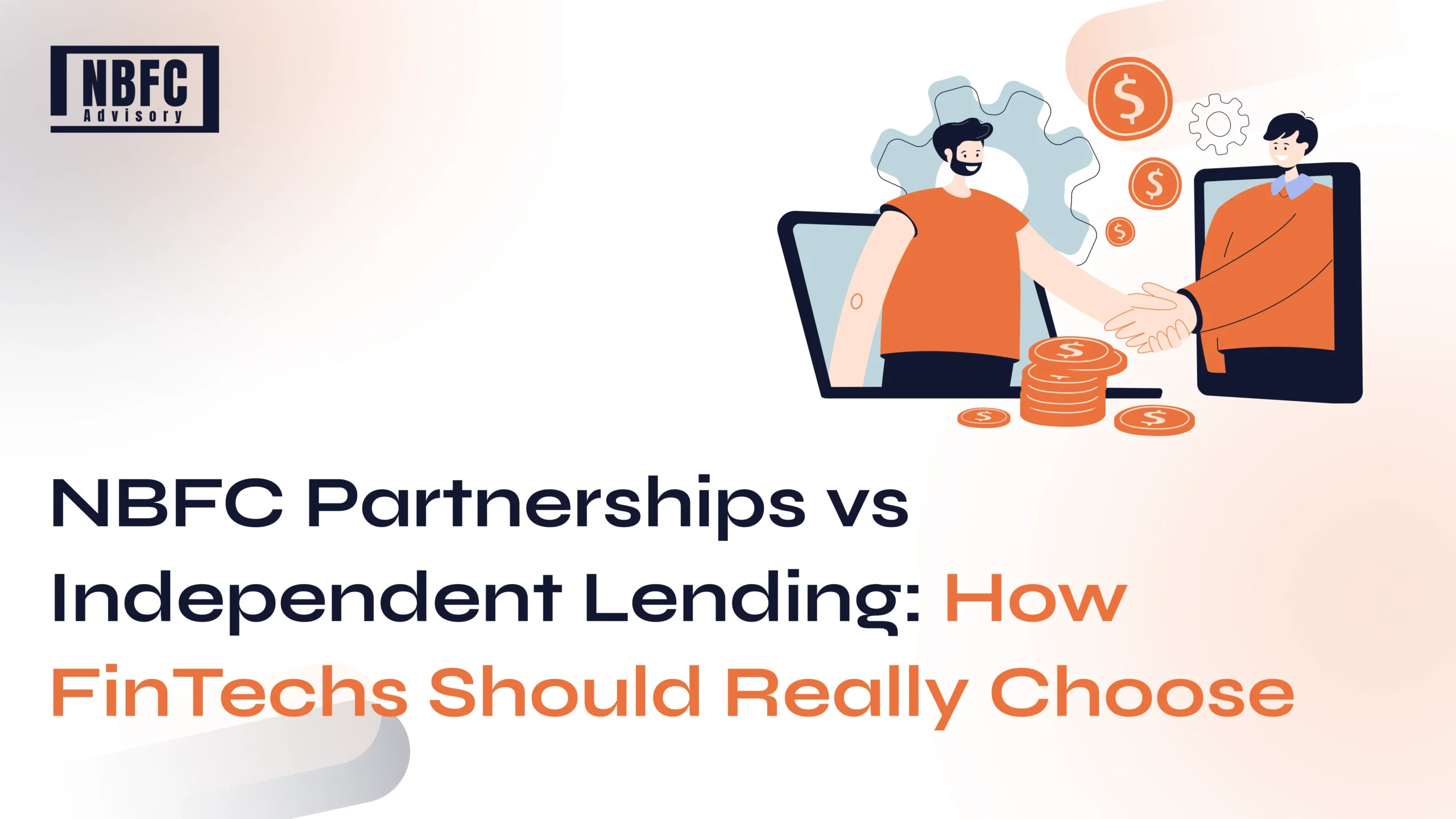
NBFC collaboration means a FinTech company teams up with a licensed NBFC to give loans.
The NBFC is the official lender that follows all the rules. The FinTech company handles the app, customer acquisition, loan approvals, and payments.
It is also called an NBFC partnership.
This way, new startups can start offering loans without needing their own NBFC license.
When founders say they want to partner with NBFC, this is usually what they mean.
How an NBFC partnership works in practice
In a typical nbfc partnership, the flow looks like this:
A customer applies for a loan through the FinTech platform. The FinTech uses its data and underwriting models to assess eligibility. Once approved, the loan is disbursed by the nbfc lending partner from its own balance sheet. Loan repayments go straight into bank accounts controlled by the NBFC.
The FinTech company makes money by getting fees, commissions, or a share of the profits.
From the customer’s perspective, the FinTech brand is front-facing. From a legal and regulatory perspective, the NBFC owns the loan entirely.
This distinction becomes critical during audits, disputes, or regulatory scrutiny.
Common NBFC partnership models in India
Not all nbfc collaboration structures are the same. The most common models include:
Loan Service Provider (LSP) model
This is the most widely used structure today. The FinTech acts as a service provider, while the NBFC handles lending. For most startups looking to partner with NBFC, this is the entry point.
Co-lending model
In this model, both the FinTech and NBFC jointly originate loans and share risk. This way gives better teamwork and shared goals.
It is often used by growing companies that want to be more involved, while still using the help of an NBFC collaboration.
FLDG-based arrangements
Here, the FinTech provides partial credit protection to the NBFC. While still present, this model is now tightly regulated and not every nbfc lending partner is comfortable offering it.
Multi-NBFC platform model
More mature platforms work with multiple NBFCs simultaneously. This reduces dependency on a single nbfc partnership and improves long-term resilience.
Why most FinTechs choose NBFC collaboration first
There are clear reasons nbfc collaboration dominates early-stage lending.
Speed is the biggest factor. Setting up an NBFC from scratch can take years. An nbfc partnership can be operational in weeks.
Capital efficiency matters just as much. Independent lending requires significant upfront capital. When you partner with NBFC, you avoid deploying large sums at an early stage.
Regulatory comfort also plays a role. The NBFC lending partner takes care of following all the rules and laws. This lets the FinTech company spend more time on making a great product that people really want.
This combination makes nbfc collaboration the default choice for consumer lending, MSME lending, and embedded finance platforms.
The risks and limitations of NBFC partnerships
While nbfc partnership models offer speed and flexibility, they come with real constraints.
Control is limited. Final credit policies and approvals usually rest with the NBFC.
Margins are thinner. Revenue sharing reduces upside compared to independent lending.
Dependency risk is significant. If your nbfc lending partner exits or changes strategy, your lending operations can stop immediately.
Regulatory spillover is another concern. Even as a tech platform, issues at the NBFC level can pull you into regulatory scrutiny.
This is why nbfc partner registration, due diligence, and strong legal agreements are essential. Choosing the wrong partner can stall growth or force painful pivots.
What is an independent lending model?
An independent lending model means operating your own NBFC or acquiring an existing one. In this structure, your company holds the license, deploys the capital, and owns the loan book.
Unlike nbfc collaboration, there is no intermediary. You decide the loan prices, who gets approved, how to collect payments, and how to talk to customers. But you also take all the rules and all the risk if loans are not paid back.
This model is not a shortcut. It is a long-term strategic commitment.
Regulatory reality of independent lending
Running your own NBFC involves RBI registration, minimum capital requirements, ongoing reporting, audits, and inspections. Compliance is continuous, not event-based.
Where nbfc partnership offers a buffer, independent lending puts your company directly under regulatory oversight.
This is why many founders delay independence until their underwriting models and unit economics are proven.
Advantages of independent lending
Independent lending offers full control. You are no longer constrained by nbfc partnership terms or external credit policies.
Unit economics improve as there is no revenue sharing with a nbfc lending partner.
Valuations tend to be stronger because investors value owned loan books and long-term scalability.
Strategic flexibility increases, allowing you to design products without external constraints.
Challenges of going independent
The challenges are equally real. Capital requirements are high. Compliance costs are ongoing. Credit risk sits entirely on your balance sheet.
Mistakes in underwriting or collections are more expensive when you operate independently.
This is why many companies start by choosing to partner with NBFC and move toward independence only when scale justifies it.
Cost and risk comparison
With nbfc collaboration, setup costs are low and time to market is fast, but long-term margins are limited. Independent lending requires patience and capital but offers stronger control and profitability over time.
The mistake is not choosing one model over the other. The mistake is choosing the wrong model for your stage.
Data and technology ownership in partnerships
One overlooked issue in nbfc partnership structures is data ownership. Before completing nbfc partner registration, founders must clarify who owns customer data, underwriting models, and historical loan performance data.
Poorly structured agreements can trap FinTechs in arrangements that limit future growth or prevent a smooth transition to independence.
Which model fits which business?
Consumer lending apps typically start with nbfc collaboration. MSME lenders often use a hybrid approach, beginning with an nbfc partnership and transitioning later. Embedded finance platforms almost always partner with NBFC entities to stay asset-light.
Companies aiming to become long-term financial institutions may choose independent lending earlier, provided they have capital and compliance readiness.
Transitioning from NBFC partnership to independence
A common and proven path is to start with nbfc collaboration, stabilize underwriting and collections, then pursue nbfc partner registration or acquire an NBFC. Over time, loan books can be gradually shifted.
The key is timing. Moving too early increases risk. Moving too late limits margins.
Final thoughts
Here is the reality most founders discover late. NBFC collaboration is not a shortcut, and independent lending is not a badge of credibility. Both are tools.
An nbfc partnership helps you move fast and learn. Independent lending helps you scale and control outcomes. The smartest businesses design for both, starting with one and preparing for the other.
Whether you partner with an NBFC today or plan NBFC partner registration later, success depends on choosing the right structure at the right stage. NBFC Advisory supports you end to end, from compliant NBFC collaboration and solid partnership agreements to smooth NBFC partner registration, so you can scale legally and confidently.
Need expert guidance? Get in touch with our consultants today.
📞 Call NBFC Advisory: +91 93287 18979
🌐 Visit: nbfcadvisory.com