
In India, non-banking financial companies (NBFCs) are an important part of the financial system. They do many things that banks do like giving loans, helping with investments, and offering asset finance. But NBFCs cannot take money from the public as deposits like banks can.
To run legally, every NBFC must get an NBFC license from the Reserve Bank of India (RBI). This license, also called a Certificate of Registration (CoR), is given under the RBI Act of 1934.
The NBFC license is very important. It shows that the company is trusted, follows RBI rules, and can work in the financial market. It also helps the company raise money and build trust with investors and customers.
If an NBFC loses this license or if the RBI cancels or takes it back the company must stop all its NBFC work right away. That’s why it’s so important to know how NBFC license cancellation happens, what causes it, and how to prevent it.
Importance of RBI Licence for NBFCs
The NBFC license (CoR) is not just a piece of paper. It is a must for any company that wants to run as a non-banking financial institution in India. As per Section 45-IA of the RBI Act, every NBFC needs approval from the Reserve Bank of India (RBI) before starting business. Without this license, the company is breaking the law.
The license gives the company legal status and shows that it follows RBI rules. It also makes sure the NBFC keeps proper records, audits, and enough capital (called Net Owned Funds). The RBI keeps watch to ensure fair and safe operations.
Having an NBFC license also builds trust. Borrowers, lenders, and investors know the company is checked and approved by the RBI. This helps the NBFC get funds, find business partners, and work honestly.
If the company loses this license, it cannot lend money or make investments legally. Keeping the NBFC license active and in good standing is therefore very important.
Grounds for NBFC Licence Cancellation
When the RBI cancels an NBFC license (also called a Certificate of Registration), it does so for specific reasons. These reasons are clearly listed by the RBI.
- One major reason is not following RBI rules for example, if an NBFC fails to send required reports on time or ignores RBI instructions.
- Failure to maintain Net Owned Funds (NOF) as required under regulations.
- Irregularities in financial statements, mis-reporting, lack of proper audit or concealment of information.
- Violation of fair practice codes e.g., misuse of customer funds, unfair lending practices.
- Inactive or dormant operations (i.e., the NBFC stops carrying on the business of a non-banking financial institution).
- Engaging in prohibited activities or using the NBFC entity for unrelated purposes.
If an NBFC fails in any of these, it faces the risk of its NBFC licence being cancelled.
RBI’s Authority and Process for Cancellation
Under Section 45-IA(6) of the RBI Act, the RBI can cancel the certificate of registration of an NBFC. The process generally involves these steps:
- RBI identifies a concern (non-compliance, irregularity, etc).
- RBI issues a show-cause notice to the NBFC, stating reasons why cancellation may be considered.
- The NBFC is given an opportunity to respond or rectify the issue.
- RBI reviews the response, conducts further examination (inspections, audits, etc) if necessary.
- If RBI remains unsatisfied, it issues a final cancellation order and the NBFC licence is revoked.
- From the date of cancellation, the entity must stop carrying on NBFC business.
This means an NBFC should take every show-cause notice from the RBI very seriously. It must reply carefully, keep proper records, and show proof that problems were fixed. Once an NBFC license is cancelled, the effect is quick and serious.
Common Triggers Leading to Cancellation
In practice, certain patterns are more likely to lead to licence cancellation:
- Repeated or prolonged non-submission of returns / regulatory disclosures.
- Weak or poor corporate governance means the NBFC’s board or managers are not doing their job well. This can include careless supervision, unqualified leaders, or personal conflicts that affect decisions.
- Directors or promoters being declared unfit, disqualified or involved in irregularities.
- Breach of prudential norms: e.g., exposure limits, asset classification, provisioning norms.
- A quick fall in financial health can also cause problems. This happens when the Net Owned Funds (NOF) go below the required level, when bad loans (NPAs) increase, or when the company risks becoming insolvent.
- If an NBFC has a license but isn’t doing any real business, the RBI can take action. Regulators expect every licensed NBFC to stay active and run its business properly.
These triggers often precede the formal cancellation of the NBFC licence.
Voluntary Surrender of NBFC Licence
Not every NBFC loses its license because of problems. Some companies choose to give up their NBFC license on their own. This happens when an NBFC decides to close, join another company, or change its business, like becoming a Core Investment Company.
To surrender the license, the NBFC must apply to the RBI, clear all dues, finish its accounts, and get approval from its board. After the RBI agrees, the license is cancelled, and the company must stop doing NBFC business.
Voluntary surrender is often easier and cleaner than forced cancellation. But it still requires care; the company must settle all debts and inform everyone connected to the business.
Aftermath of Licence Cancellation
When an NBFC licence is cancelled (or surrendered), the consequences are significant:
- If an NBFC loses its license, it must stop all lending, finance, and investment work right away.
- This can create confusion for people connected to it such as borrowers, lenders, or depositors. In some cases, the RBI may take control or help close down the company.
- Losing an NBFC license also hurts the company’s name. Investors and business partners may lose trust, seeing it as a warning sign.
- There can also be legal and money-related problems. If the NBFC broke rules or acted wrongly, it could face fines or other action from the regulator.
- When many licenses are cancelled, it usually means the RBI is making the system stricter and removing weak or risky companies.
In short, losing an NBFC license is serious it affects the company, its customers, and its reputation.
Remedies and Appeal Process
If an NBFC believes its licence has been cancelled unfairly, there is an appeal mechanism. The NBFC may file an appeal against the cancellation order under Section 45-IA(7) of the RBI Act, typically within 30 days. Further, in some cases, judicial review may be possible via high courts under writ jurisdiction (article 226).
In reality, getting an NBFC license back is uncommon. It only happens when the company shows clear proof that it has fixed all major problems, improved its management, and followed every rule. The board should carefully decide if filing an appeal is worth the cost and effort, or if it’s better to close the NBFC and move on.
How to Avoid Licence Cancellation
Prevention is far better than cure. To safeguard the NBFC licence, management and boards should adopt the following practices:
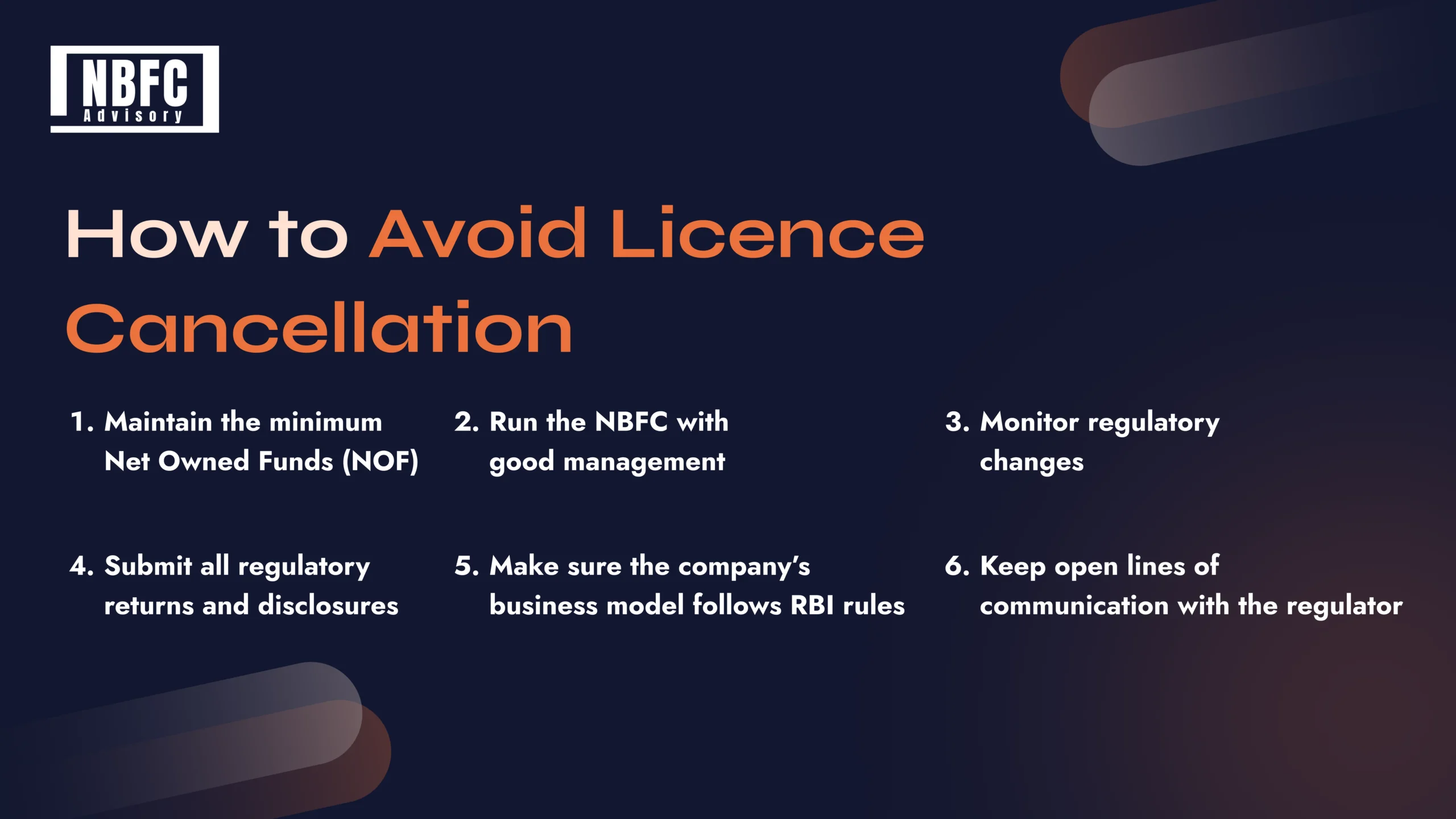
- Maintain the minimum Net Owned Funds (NOF) and ensure any decline is addressed promptly.
- Submit all regulatory returns and disclosures accurately and on time.
- Conduct regular internal audits, compliance reviews and ensure transparency in operations.
- Run the NBFC with good management. Have honest and skilled board members, clear rules for handling risks, and close supervision of owners and managers.
- Make sure the company’s business model follows RBI rules. The NBFC should stay active in its main line of work and meet the principal business test set by the regulator.
- Monitor regulatory changes continuously (RBI circulars, notifications) and update policies and procedures accordingly.
- Keep open lines of communication with the regulator when challenges arise, rather than hiding problems.
If an NBFC follows rules and manages its work properly every day, the chance of losing its license becomes much lower.
Recent Case Studies and RBI Actions (with Recent Data and Links)
Let’s bring in some recent data to illustrate how licence cancellations and surrenders are playing out:
- In September 2025, the RBI announced it had revoked the certificate of registration of 35 NBFCs, of which 14 were surrenders. ETBFSI.com
- Earlier, the RBI announced that nine NBFCs gave up their licenses and 31 NBFCs had their registrations cancelled. The Economic Times
- In one case, the RBI cancelled the license of Datta Finance & Trading Pvt. Ltd. on 22 September 2025 because the company broke the rules for digital lending.adda247
- These facts show that the RBI is letting some NBFCs leave the market but is also making sure others strictly follow the rules.
What this signals for NBFC licence holders:
- Right now, the risk is high. Many NBFC licenses are being cancelled or surrendered, which shows that the RBI has very little patience for rule-breaking.
- Not all NBFCs are being forced to close. Many are choosing to give up their licenses because keeping the license and meeting RBI’s rules has become expensive and difficult.
- The pressure is highest on smaller or under-capitalised NBFCs. Entities that struggle with NOF, governance or filings are more likely to lose their NBFC licence.
- For the industry as a whole, this is part of a consolidation and clean-up phase NBFC licence holders need to map where they stand and act accordingly.
Conclusion
Holding an NBFC licence is essential for any entity wanting to operate as a non-banking financial company in India. Losing an NBFC license, whether it’s cancelled or given up, is a major event. It can stop the company’s work, reduce trust, and create big financial and legal problems.
The key take-away: maintaining your NBFC licence isn’t about ticking a box once. It means always having enough funds, following the rules, running the business well, filing reports on time, and staying active. In the current climate, regulatory scrutiny is high and the cost of inaction is steep.
If you are part of an NBFC’s board or management, treat the license as valuable and delicate. Build strong rules, checks, and systems to protect it. Because once the NBFC licence is gone, rebuilding is far harder than preserving.
Need expert help to protect your NBFC license? Talk to an NBFC advisory expert for easy advice on rules, management, and compliance so your NBFC stays strong and follows RBI guidelines.
Call NBFC Advisory: +91 93287 18979
Visit: nbfcadvisory.com
Frequently Asked Questions (FAQs)
What exactly is an NBFC licence?
An NBFC license is a certificate given by the RBI that allows a company to do NBFC business under the rules of the RBI Act.
Can an NBFC legally operate without this licence?
No. Running an NBFC without a license is against the law. The RBI can take action such as cancelling the business, filing legal cases, or charging penalties.
What are the major reasons why the RBI cancels an NBFC licence?
The main reasons are not having enough money, not sending reports, bad management, wrong financial records, or stopping the NBFC’s work.
How often does the RBI cancel these licences?
In September 2025, the RBI said that 35 NBFCs lost their licenses and 14 gave them up on their own.. ETBFSI.com
If an NBFC licence is cancelled, can it be restored?
In some cases, yes — if the NBFC fixes its mistakes, it can appeal to the RBI or court to get the license back. There are precedents where licences were restored. The Economic Times
What’s the difference between voluntary surrender and forced cancellation of the NBFC licence?
Voluntary surrender means the NBFC decides to exit NBFC business and applies to relinquish the licence. Forced cancellation means the regulator revokes it due to non-compliance or misconduct.
What should an NBFC do to avoid licence cancellation?
Keep enough money, send reports on time, manage the company well, check accounts regularly, follow RBI rules, and stay active in NBFC work.
Does the size of the NBFC matter when it comes to licence cancellation risk?
Yes — smaller NBFCs with thin capital, weaker disclosures or operational inactivity tend to face higher risk. But even larger NBFCs can be affected if governance/compliance is weak.
What happens to borrowers or customers of an NBFC when the licence is cancelled?
The NBFC must stop NBFC business. Borrowers still need to repay their loans, but customers and lenders should check how the company is handling its debts and payments. Regulatory oversight helps protect customer interest.
Why is recent data showing many NBFC licence cancellations relevant?
This shows that the RBI is becoming stricter. It is removing weak NBFCs, making sure rules are followed, and not allowing rule-breaking anymore. NBFC licence holders must treat this as strategic risk.